

A nursery air purifier runs without complaint for three weeks, then starts pushing out a sour, wet-towel smell. Complaints like this reach service teams often enough that they keep written checklists for them, and in most teardown reports the cause is not the same component twice. Nearly every case settles into five sources: volatile compounds escaping from new parts, dust packed onto the pre-filter, carbon media that has taken on moisture, a filter that has already absorbed everything it can hold, and, far less often, ozone or a heated component. Identify the smell first, and the repair usually follows without guesswork.
The conclusion is simple enough to state before the evidence. A smelly air purifier is usually not broken, it is asking for maintenance, drying, or a replacement filter. The exception is the burning smell and the sharp ozone smell, which call for cutting power and inspecting the unit rather than buying new media. Everything else is a matter of reading which part has reached the end of its working life.
Content
A matching table belongs near the top of any troubleshooting routine, because the smell signature narrows the field faster than the model number does. A sour, musty machine and a machine with a hot plastic odour need completely different handling, and treating them as one fault usually ends with the owner replacing a filter that was still perfectly good.
| Smell signature | Most likely source | First check |
|---|---|---|
| Plastic, glue, or new-electronics odour | Off-gassing from housing plastic, adhesives, and fresh filter media | Run the unit continuously for three to seven days with ventilation |
| Sour, musty, wet-towel odour | Carbon media holding moisture, or microbial growth inside the filter | Measure room humidity and confirm the filter core is dry |
| Dusty or cardboard odour | Loaded pre-filter and clogged pleats | Shine a torch through the pleats and look for grey build-up |
| Burning or hot-plastic odour | Dust on the outlet grille, heating module, or motor housing | Cut power and inspect the outlet path with a torch |
| Ozone or sharp metallic odour | An ionizer or ozone generator running at high output | Switch the ion function off and smell again after ten minutes |
Two effects make the diagnosis harder than the table suggests. A filter can smell clean for the first minute of operation and turn sour a few minutes later, because airflow pulls stored moisture from deep inside the media up to the surface. A smell sometimes appears worst after the machine has been switched off, since still air around a damp filter lets volatile compounds concentrate, and the next start-up releases them in one burst.
Figure 1. Why household air purifiers develop odours: share of service cases
The distribution in Figure 1 comes from residential service records, and while the ranking shifts a little from year to year, the order stays roughly stable. Carbon saturation leads the list at about a third of cases, and it is also the easiest cause for an owner to overlook: the filter looks clean, airflow has not dropped, and the only symptom is that odours have returned. Filter moisture takes a little over a quarter, and it clusters in rooms where relative humidity stays above 60 percent, including bathrooms and basements. Dust build-up ranks third, and owners frequently assume a replacement filter is needed when a single pre-filter wash restores performance. Break-in odour accounts for a much smaller share, which is why a unit that smells slightly odd for two or three days after purchase rarely needs a repair visit. Ozone and hot-component odours are the rarest group and also the one group that has nothing to do with air quality and everything to do with electrical safety.
The smell of a new machine is almost always several components off-gassing at once. Injection-moulded housings release residual volatile organic compounds for the first few days after demoulding, adhesives and sealant typically release more, compressed filter media contribute a papery note because of their large surface area, and the grease in the motor bearings adds a faint oily trace. Stack those together and you get what most owners describe as a plastic smell.
Figure 2. Break-in odour duration by component under continuous operation
Figure 2 shows the number of days each component needs before its odour falls below the level most people can notice, measured under continuous operation in a ventilated room. Adhesives and sealant linger longest at close to a week, housing plastic clears in about five days, and motor grease fades after roughly four. Filter media and the carbon layer are the quickest to settle, usually within two or three days. Those figures assume the machine runs continuously, so an owner who switches it on for half an hour at a time should expect the process to stretch considerably. Running a new unit for a full week in a well-ventilated room works far better than repeatedly toggling it on and off, which is the pattern most manufacturers describe in their run-in guidance for everyday operation. If a distinct plastic smell is still there after two weeks, it is no longer break-in behaviour and the fan or power section needs inspection.
Sourness and mustiness can be traced to activated carbon with very few exceptions. Carbon works through an enormous microporous surface area, and the adsorption process is reversible: raise the temperature, raise the humidity, or change the concentration gradient, and molecules that were captured earlier partially desorb back into the room. Many composite filters sandwich carbon between two non-woven layers, and in sustained high humidity a water film forms inside that sandwich, giving microorganisms a place to grow. The metabolic by-products they release smell worse than the original odour. A reliable signal is a machine that smells of nothing while running but produces its strongest smell in the first minute after being switched on following several idle hours.
Three steps fix it. Measure room humidity and keep long-term levels below 60 percent, confirm whether the filter core is actually dry and air it out in shade rather than direct sun if needed, and replace the media outright if the sour note returns within two or three days of drying, since that means the carbon is saturated or the growth has taken hold. Water-based air washing products follow a different route, capturing particles and some water-soluble gases at a water film instead of relying on a heavy carbon load, which lowers the odour risk from the filter itself. The water tray in that design still has to be emptied and refilled on a short cycle, otherwise the problem simply moves from the filter into the water.
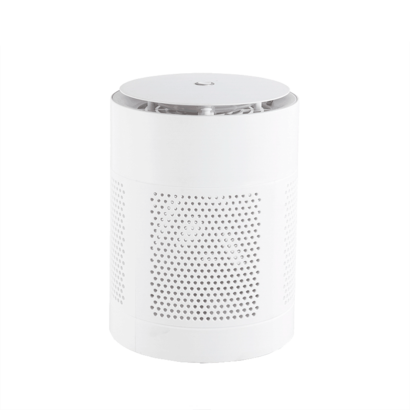
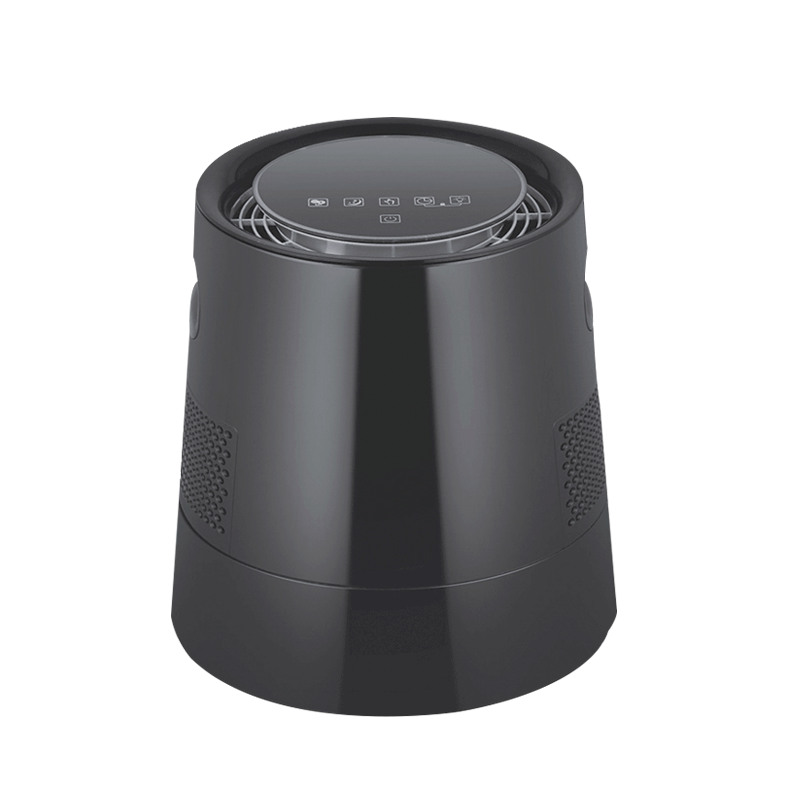 House Portable Ion Airwasher LG-01continuous running timeView Product →
A hot or burning smell sits in a different category from everything above, and the filter is rarely involved. Dust that settles on the fan blades, the motor housing, or a heating module inside the same cabinet will char slowly and produce exactly the note people describe as burning plastic. The effect is strongest in units that run for long stretches without the pre-filter being cleaned, and it worsens in rooms with cooking fumes, candles, or cigarette smoke.
Handling is straightforward. Cut the power at the wall, remove the grille, and clear the dust with a soft brush and a vacuum rather than a wet cloth, since moisture near live parts creates a second problem. If the smell appears within seconds of start-up rather than after an hour of running, leave the unit unplugged and have the electrical section checked before using it again.
Carbon does not fade at a steady rate, which is why replacement calendars so often get it wrong.
Figure 3. Odour and particle removal retained over six months of typical use
Solid line: odour removal retained. Dashed line: particle removal retained.
The curves in Figure 3 follow a typical accelerated ageing run. During the first two months the drop in odour removal is barely visible, falling from 100 to roughly 92 percent, and most owners register no change at all. Between the third and fourth month the curve steepens sharply and odour removal drops to around 65 percent, which is exactly the point at which people start saying the smell has come back. Over the same period the particle removal side only slides from 100 to about 94 percent, and that gap between the two lines explains the widespread misjudgement that a filter still has plenty of life left. The shape of the curve also shows that carbon life tracks the total mass of gas it has absorbed, so media in a kitchen that sees daily cooking or in a room with a smoker is consumed far faster than media in an ordinary bedroom. Replacing on a fixed monthly schedule is a rough approximation at best, and watching for the return of odours is the more accurate trigger.
For brands and importers, most of the control over this problem sits in the filter specification rather than in the finished unit.
Figure 4. Coconut-shell versus coal-based carbon across six sourcing criteria
Blue outline: coconut-shell carbon. Orange outline: coal-based carbon.
Figure 4 compares coconut-shell carbon against coal-based carbon on the six criteria that buying teams argue over most. Coconut carbon normally posts a clearly higher iodine value, with finer micropores that hold small odour molecules better and deliver a longer useful life for the same weight of media. Coal-based carbon competes on price, often landing near half the cost of coconut, and it suits cost-sensitive models with short service cycles. Humidity stability deserves separate attention: coconut carbon has greater mechanical strength and resists powdering after repeated wet and dry cycles, and powdered carbon does not just fail to adsorb, it releases fine dust that can pass through the media and into the air path. Poor dust control shows up to the user as a grey, dusty note that they will read as weak purification rather than as a material fault. Writing iodine value, fill weight, moisture content, and dust release into the specification sheet is far more reliable than naming a filter type and hoping the supplier interprets it the same way.
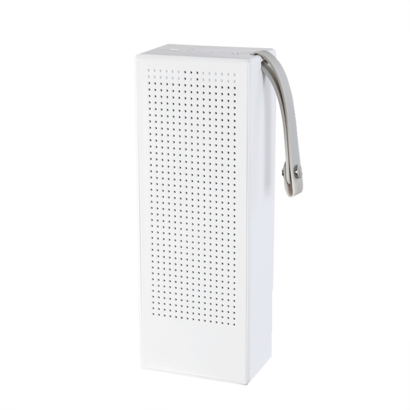
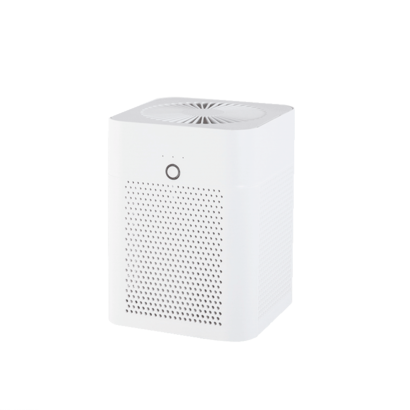
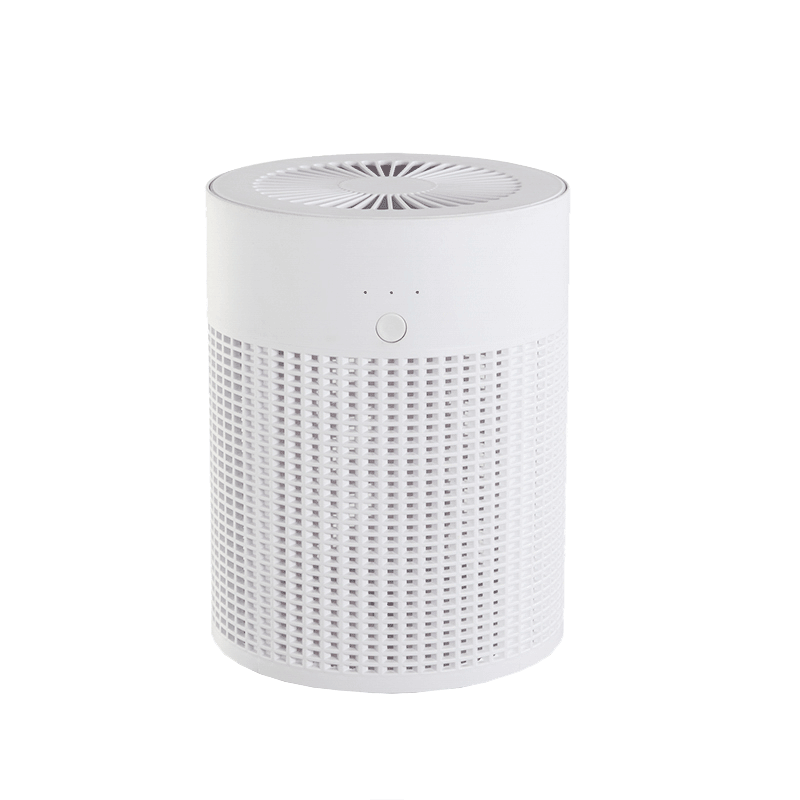 Portable Mini Air Purifier AP-01ACixi Xiatian Electrical Appliances CO.,LTD was founded in 2011, professional manufacturer and supplier of Portable Mini Air Purifier AP-01A. Workshop is 30,000 square ...View Product →
Structural problems of this kind surface early in sampling. Placing a prototype in a humidity chamber for a wet cycle, then running it for several hours and smelling the outlet, tells a buyer more than any paper specification. Manufacturers with their own laboratory can run both the humidity cycle and the material odour rating in house, and export-oriented suppliers are usually able to document odour intensity for plastic parts and adhesives against the evaluation methods their customers use.
Work through the list in order and most smelly air purifiers resolve without a service call. Match the smell to a component, dry or replace the carbon if the note is sour, clean the pre-filter and the outlet path if the note is dusty or hot, and give a new unit a full week of continuous operation before judging it. Buyers placing volume orders should push the same logic one step upstream, into iodine value, fill weight, moisture resistance, and dust release on the specification sheet, because those four numbers decide how the finished unit will smell eight months after it leaves the line.

@2020. CIXI XIATIAN ELECTRICAL APPLIANCES CO.,LTD. All rights reserved. Wholesale High-End Electric Fans Manufacturers

 English
 한국어
한국어