In early 2020 a buyer for a small dental clinic asked a direct question: will an air purifier stop COVID-19. The honest answer has not changed since. A purifier is not a vaccine and it is not a physical barrier. What a properly sized unit can do is shorten the time infectious aerosols stay suspended in a room, and in a closed office or bedroom that is a real and measurable contribution.
So here is the conclusion first. An air purifier earns its place in a COVID risk reduction plan when three conditions are met. It moves enough clean air for the volume of the room, it uses a genuine HEPA or ePM1 grade filter inside a tight housing, and it runs continuously in the space where people actually breathe. Miss any one of those and the machine becomes a quiet box with a light on it. The app, the ion count on the packaging and the colour of the housing do not change the outcome.
Content
The virus does not travel on its own. It rides inside respiratory particles, from large droplets that settle within a meter or two to fine aerosols that can stay airborne for minutes to hours in a room with little ventilation. A mechanical filter does not need to recognise the virus. It only has to capture the particle the virus is attached to, which is why filter performance is quoted in particle size and percentage removal rather than in pathogens.
Public health guidance from the CDC and the NHS places portable air cleaners with HEPA filters inside a layered strategy, alongside ventilation, distancing and vaccination. It is a supporting measure. It lowers the concentration of infectious particles in room air, which lowers the chance that someone inhales a dose large enough to cause infection, but it does not make a crowded room safe on its own. A purifier also cannot remove the virus from a person who is already infected, cannot protect you during a close face to face conversation in a poorly ventilated space, and cannot compensate for a filter that leaks around its frame, because unfiltered air takes the easiest path.
What it can do is steadily reduce the airborne particle load in a closed space. A unit delivering 200 cubic meters of clean air per hour in a 30 cubic meter bedroom adds close to seven air changes per hour, and at that rate the concentration of fine aerosol falls by more than 90 percent within the first half hour. That mechanism is the whole benefit, and it is worth having when the unit is sized and sealed correctly.
Filter naming is where most buyers get lost. True HEPA is a performance class, not a marketing word. Under EN 1822, H13 media must remove at least 99.95 percent of particles at the most penetrating particle size, which for common media sits between 0.1 and 0.3 micrometers. A virus particle is smaller than that, but it almost never travels alone, so the practical target is the respiratory particle carrying it, which is larger and easier to capture.
| Stage | Main target | Recognised specification | Limits to check |
|---|---|---|---|
| Mechanical HEPA | Fine aerosols and particles | H13 or H14 to EN 1822, at least 99.95 percent at the most penetrating particle size | Needs a tight frame seal, adds pressure drop and noise |
| ePM1 media | Fine particles in larger or ducted systems | ISO 16890 ePM1 rating | Lower single pass efficiency than HEPA |
| Activated carbon | Odors, cooking fumes, volatile organic compounds | Weight and iodine number matter more than thickness claims | Captures almost no particles on its own |
| Ionizer or electrostatic stage | Charged particles and some fine dust | Performance varies widely, test standard often unstated | Ozone byproduct, output falls as plates collect dust |
| UV-C lamp | Microbes near the lamp | Dose depends on lamp power and dwell time | Contact time in a room unit is only a fraction of a second |
The practical combination for a home or office is a washable prefilter, a mechanical HEPA stage at H13 or better, and a carbon layer if odors, cooking fumes or traffic exhaust also matter. Treat the phrase HEPA type with caution, because it has no fixed efficiency threshold, and treat a UV lamp in the airstream as a bonus rather than a replacement for the filter.
Sizing comes down to one number, the clean air delivery rate, usually written as CADR. It is the volume of filtered air the unit produces, measured on smoke, dust and pollen, and it is the only honest way to compare two machines. Ignore a claim that a unit suits rooms up to 60 square meters unless a CADR figure appears beside it, because the two statements are not the same.
Infection control work commonly targets five air changes per hour in a room where people spend time together. Five air changes per hour means the purifier must deliver five times the room volume every hour. A room of 30 square meters with a 2.5 meter ceiling holds 75 cubic meters of air, so the target is 375 cubic meters per hour, roughly 220 cubic feet per minute.
| Floor area | Room volume | CADR in cubic meters per hour | CADR in cubic feet per minute |
|---|---|---|---|
| 10 square meters | 25 cubic meters | 125 | 74 |
| 20 square meters | 50 cubic meters | 250 | 147 |
| 30 square meters | 75 cubic meters | 375 | 221 |
| 50 square meters | 125 cubic meters | 625 | 368 |
| 80 square meters | 200 cubic meters | 1000 | 589 |
Two corrections matter before you use the table. First, CADR is measured at the highest fan speed, which is usually too loud to live with, and running the same unit on medium typically delivers 40 to 60 percent of the rated figure, so size up rather than size to the label. Second, a large open plan space does not behave like one room unless the air mixes well, so treat a 60 square meter office as two or three zones with a unit in each.
Placement decides how much clean air reaches your breathing zone. Keep the unit at least 30 centimeters from walls and furniture, out of corners, and ideally between the people in the room and the air they share. In a bedroom, a spot near the head of the bed beats a corner on the far side. In a meeting room, let the unit pull room air rather than blow directly at a person, because a direct stream from one seated person to another is the pattern you are trying to avoid. Runtime matters as much as size. Filtration is a continuous process, so a unit switched on for an hour after a meeting delivers far less than the same unit running all day.
Running cost is mostly filters, not electricity. A realistic schedule looks like this.
Budget the annual filter cost before buying three units instead of one. Two well maintained purifiers in the right rooms will outperform five neglected ones.
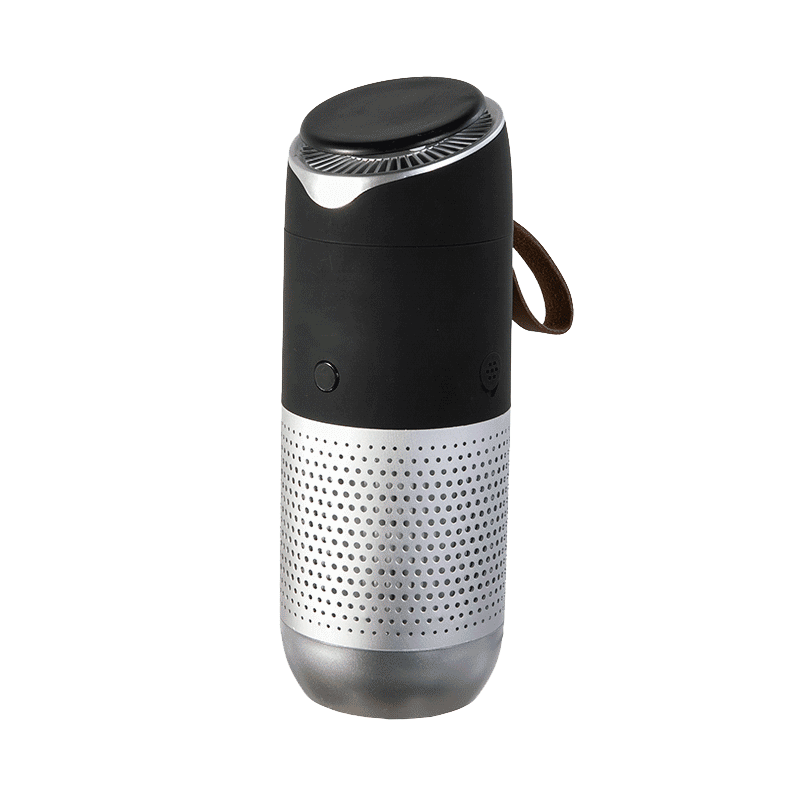
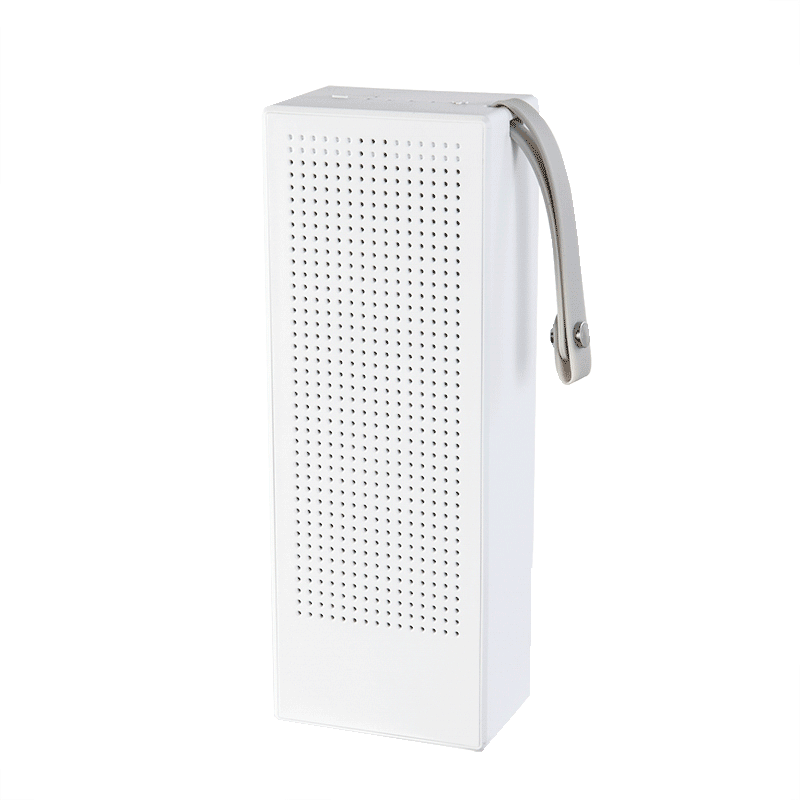
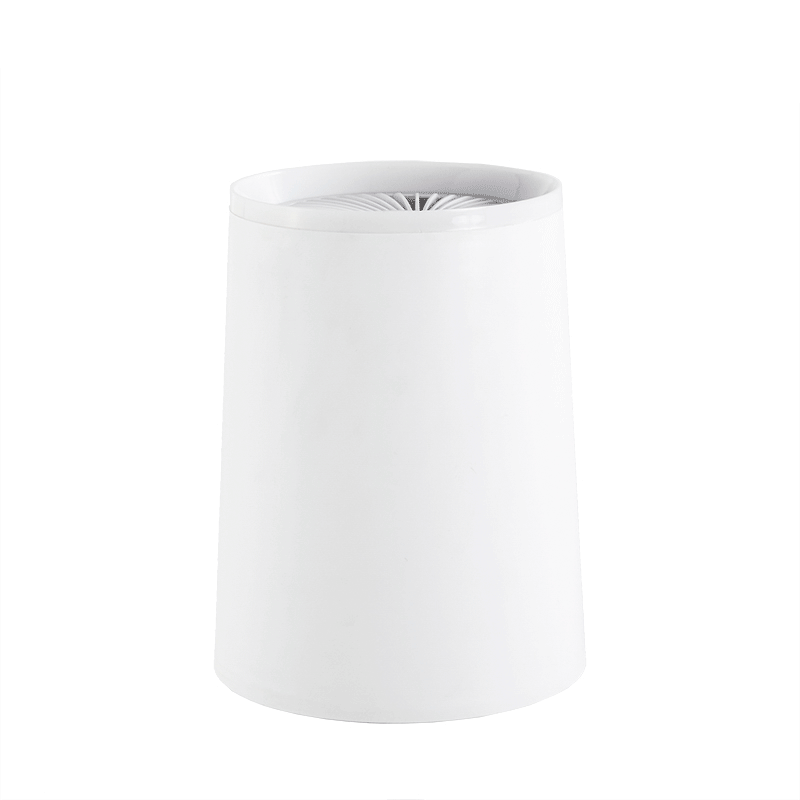
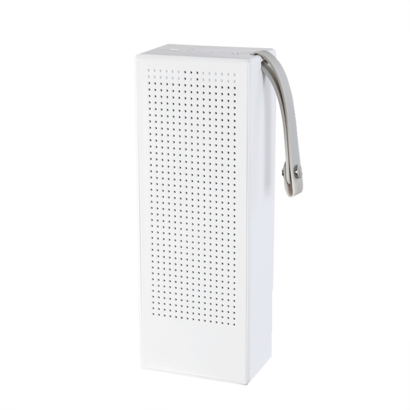
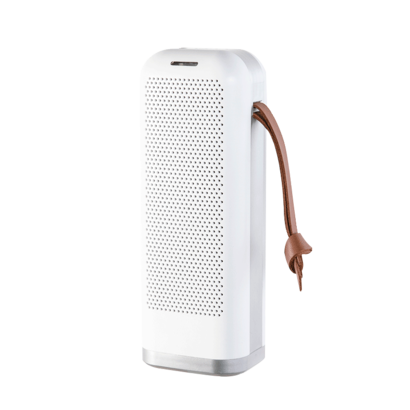
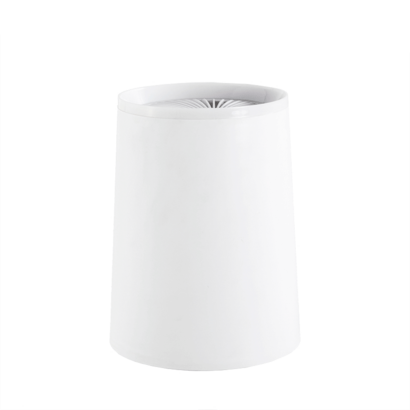
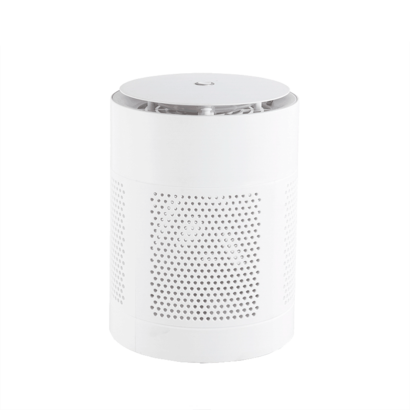
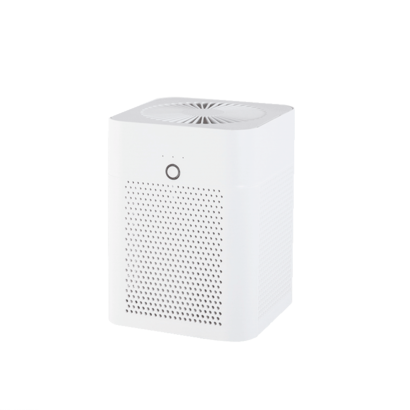
Not every situation needs a floor standing machine. A single office, a treatment room, a hotel room or a car cabin is often better served by a compact purifier with a footprint small enough for a desk. These units are limited by fan size and filter area, so they work best within two or three meters of the user rather than for a whole room.
Portable and rechargeable models are also the practical answer where outlets are scarce or where the unit has to follow the person, such as a shared desk in a flexible office. Check two things on this class of product, whether the battery drives the fan at a useful speed and for how long, and whether the filter is a real HEPA element rather than a thin non woven pad. A compact purifier with a small filter and a quiet fan is a personal air cleaner, not a room solution.
When you source rather than buy retail, the technical argument above becomes a document. Three items belong in it from the start. State the filter class by standard, so H13 to EN 1822 rather than high efficiency HEPA. State the CADR at every fan speed together with the sound pressure level in decibels at each of those speeds. State the leakage test the factory will run on the finished unit, because a HEPA filter inside a loose housing is a claim rather than a filter.
Beyond filtration, the details that decide whether a program ships on time are tooling, compliance and capacity. Certifications for the destination market, such as CE, GS, ETL or PSE, need to be planned into the tooling schedule rather than added after the first container. Cosmetic customization, from housing colour to control panel layout, normally becomes available once annual volume justifies a mold. A manufacturer with its own injection molding, stamping and tooling can usually absorb design changes faster and at lower cost than one that assembles bought in parts.
That is the model behind our own air purifier, air washer, fan and heater lines, produced in a 30,000 square meter workshop in Cixi, Ningbo, with about 60 engineers, an in house test laboratory and annual capacity of roughly one million air purifiers and 250,000 air washers. Units ship to Korea, Russia, Italy, Poland, Spain, the United Kingdom, Australia and other markets, and development can follow a customer drawing or a supplied sample. For more detail, see our factory profile and quality control process.
No. Mechanical HEPA filtration removes the particles the virus travels on. Some units add UV-C or an ionizer, but in a room sized product the kill claim is hard to verify and the contact time is short. Removal, not killing, is the dependable mechanism.
No. Air has to reach the unit. A single purifier in a hallway will not protect a closed bedroom. Use one per room where people spend time, or move one unit with you and give it time to work before the room fills.
Start it at least 30 minutes before people arrive and leave it running throughout. With five or more air changes per hour, particle levels drop quickly at first and then more slowly, so the final few percent of reduction takes much longer than the first half. Filter selection, sizing and maintenance questions are covered in more detail on our frequently asked questions page.
A purifier is a modest tool, and it works only inside its limits. Size it for the room by airflow, insist on a real HEPA class filter with a sealed housing, run it continuously, and keep the filters clean. Do those four things and filtration quietly removes a meaningful share of the airborne particles that carry SARS-CoV-2 and other respiratory viruses. Skip them and you have bought a fan with a filter shaped accessory.

@2020. CIXI XIATIAN ELECTRICAL APPLIANCES CO.,LTD. All rights reserved. Wholesale High-End Electric Fans Manufacturers

 English
 한국어
한국어