

Fan Heater are popular for their compact size, quick heating, and flexible use. The core function of an air heater is to convert electrical energy into heat and transfer that heat to the surrounding area through forced convection. Its workflow can be summarized in the following simple steps:
Content
The key component inside an air heater is the heating element, typically made of materials such as resistance wire, PTC ceramics, or mica sheets. When current passes through these high-resistivity materials, according to Joule's law (Q=I²Rt), the electrical energy is efficiently converted into heat, rapidly heating the heating element.
Unlike traditional radiant electric heaters, Fan Heater have a built-in fan. This fan draws in cool air from the room through the air inlet.
The drawn-in cool air flows over the hot surface of the heating element. During this contact, the cool air absorbs heat and quickly becomes warm air.
Finally, a fan forces the heated air out through the outlet, quickly raising the indoor temperature and achieving space heating.
The working principle of a fan heater is: the heating element generates heat → the fan distributes air → warm air is generated → the space is heated.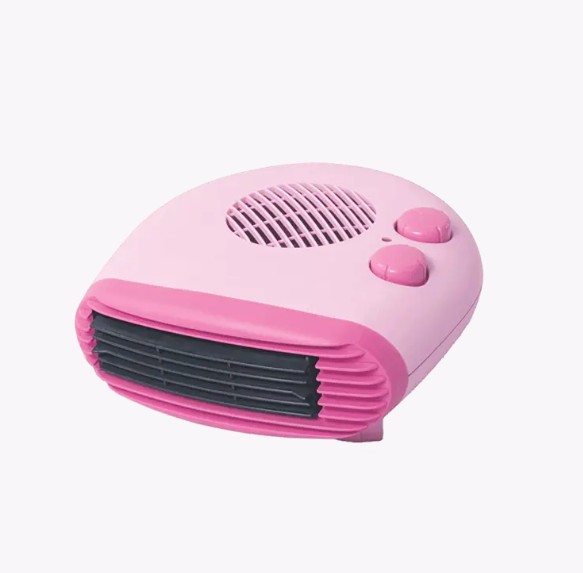
Different types of fan heater use different heating elements, each with its own advantages in terms of heating efficiency, safety, lifespan, and price:
Operating Characteristics: Using PTC (Positive Temperature Coefficient) material, the most significant feature is its constant-temperature heating capability. As the temperature rises, the resistance of the PTC element increases dramatically, automatically reducing the heating power to maintain the surface temperature within a certain range.
Advantages: Extremely safe, as it does not produce open flames and automatically controls the temperature to prevent overheating. Furthermore, PTC heaters offer high heating efficiency and a long service life.
Operating Characteristics: This is the most traditional heating element, typically composed of a resistance wire made of a high-resistivity material such as nickel-chromium alloy. When current flows through it, the resistance wire heats up rapidly.
Advantages: Low cost, mature technology, and fast heating speed.
Operating Characteristics: The heating wire is evenly wrapped around a mica sheet. The mica sheet serves as insulation and support, as well as a thermal conductor.
Advantages: Excellent insulation and relatively uniform and stable heating.
While a fan heater provides warmth, safety is crucial. High-quality fan heaters often incorporate multiple safety features, such as:
When selecting a heating device, understanding how a fan heater works can help you better evaluate its performance. Because the fan heater uses forced convection heating, it can heat up quickly and is particularly suitable for small spaces or areas that need instant supplemental heat.

@2020. CIXI XIATIAN ELECTRICAL APPLIANCES CO.,LTD. All rights reserved. Wholesale High-End Electric Fans Manufacturers

 English
 한국어
한국어