

An air purifier works by drawing room air through a fan, passing it through one or more filter stages that capture or neutralize airborne contaminants, and then returning the cleaned air back into the room. The process is continuous — the unit cycles through the room's air volume repeatedly, progressively reducing the concentration of dust, allergens, smoke particles, mold spores, gases, and odors with each pass.
Different filter technologies target different types of pollutants. A mechanical HEPA filter captures solid particles. An activated carbon layer adsorbs gases and odors. Some units add UV-C light or ionization stages to address bacteria and viruses. The combination of stages in a single unit determines what it can and cannot remove from the air — and how effectively it does so.
The result is a measurable and sustained improvement in indoor air quality: lower particle counts, reduced allergen levels, fewer airborne irritants, and a noticeably fresher indoor environment — particularly important for people managing allergies, asthma, mold sensitivity, or respiratory conditions.
Content
At the most fundamental level, every air purifier — from a compact mini unit to a large whole-room system — operates on the same physical principle: forced air movement through a filtration medium. Understanding the airflow path clarifies why each component matters.
The internal fan creates negative pressure at the air intake vents, typically located on the sides or rear of the unit. This draws ambient room air — containing a mixture of particles, gases, and moisture — into the purifier housing. The fan speed directly determines how much air volume is processed per unit of time, measured as the Clean Air Delivery Rate (CADR) in cubic meters or cubic feet per minute.
The incoming air first passes through a coarse pre-filter — sometimes combined with an activated carbon layer — that intercepts large particles such as hair, lint, large dust clumps, and pet fur. This protects the downstream fine filters from becoming prematurely clogged, extending their useful life significantly. Many pre-filters are washable, making them a low-cost, reusable first line of defense.
The pre-filtered air then passes through the HEPA filter, which is the core particle-removal stage. Fine particles are captured through a combination of physical mechanisms — interception, impaction, and diffusion — across the dense fiber matrix. Particles at 0.3 microns are the most penetrating particle size (MPPS), and a certified True HEPA filter must capture at least 99.97% of particles at this size. Larger and smaller particles are actually captured at even higher efficiency rates.
After HEPA filtration, the now particle-reduced airstream passes through an activated carbon layer. Carbon adsorption is a chemical process: gaseous molecules including volatile organic compounds (VOCs), cooking odors, tobacco smoke gases, chemical fumes, and formaldehyde bond to the enormous surface area of the porous carbon granules and are removed from the airstream. A single gram of activated carbon can have an internal surface area exceeding 1,000 square meters — which is why even a relatively thin carbon layer can have a substantial odor-control capacity.
The filtered air exits through the outlet vent, typically directed upward or outward into the room. This creates a gentle circulation pattern that gradually mixes the cleaned air with the remaining room air, steadily diluting and replacing the polluted air volume. The fan continues to run, drawing in the next volume of room air for processing — completing the continuous cycle.
Many people assume a HEPA filter works like a simple physical sieve — blocking particles larger than the gaps between fibers. In reality, HEPA filtration relies on three distinct physical mechanisms, each most effective at a different particle size range. This is why HEPA filters achieve such high efficiency across a very wide range of particle sizes.
As airflow carries a particle along a curved path around a fiber, the particle's trajectory keeps it close to the fiber surface. If the particle passes within one particle-radius of the fiber, it makes contact and adheres due to Van der Waals forces. Interception is most effective for medium-sized particles in the range of 0.5 to 5 microns — a range that includes many common allergens such as dust mite fragments and pet dander particles.
Larger, heavier particles cannot follow the curved airflow path around a fiber because their inertia carries them in a straight line. They impact directly onto the fiber and are captured. Impaction is dominant for particles larger than approximately 1 micron, including pollen grains, mold spores, and large dust particles. The faster the airflow, the more effective impaction becomes — which is one reason higher fan speeds can improve particle capture efficiency for coarser particles.
Very small particles — those below approximately 0.1 microns — are so lightweight that they do not follow the airstream in an orderly path. Instead, they undergo Brownian motion: random, erratic movement caused by collision with gas molecules. This randomness dramatically increases the probability of contact with a filter fiber, making diffusion the dominant capture mechanism for ultrafine particles, including certain bacteria, combustion particles, and some virus-carrying aerosol droplets. Counterintuitively, the HEPA filter is actually more efficient at capturing very small particles than mid-sized particles around the 0.3 micron MPPS threshold.
A multi-stage air purifier addresses a much broader range of indoor air pollutants than a single-filter unit. The table below summarizes what each common filter type targets and its limitations.
| Filter / Technology | What It Removes | What It Cannot Remove | Replacement Frequency |
|---|---|---|---|
| Pre-filter (dust collection filter) | Hair, lint, large dust, pet fur | Fine particles, gases, odors | Clean every 2–4 weeks; replace as needed |
| True HEPA filter | 99.97% of particles ≥0.3 microns: pollen, dust mite debris, mold spores, pet dander, bacteria, fine smoke particles | Gases, VOCs, odors, viruses smaller than 0.1 microns (reduced efficiency) | Every 6–12 months; do not wash |
| Activated carbon filter | VOCs, formaldehyde, cooking odors, tobacco smoke gases, chemical fumes, pet odors | Solid particles, allergens, biological contaminants | Every 3–6 months |
| UV-C germicidal lamp | Bacteria, some viruses, mold spores (inactivation) | Particles, gases, odors; effectiveness depends on UV exposure time | Bulb replacement annually |
| Ionizer | Charges particles to accelerate settling; some reduction in airborne particle count | Does not physically remove particles from air; may produce trace ozone | No filter; cleaning plates periodically |
Clean Air Delivery Rate (CADR) is the standardized metric that measures how much filtered air an air purifier delivers per unit of time, expressed in cubic feet per minute (CFM) or cubic meters per hour (m³/h). It is the single most useful number for comparing the real-world effectiveness of different units.
CADR values are typically reported separately for three particle categories: smoke (fine particles around 0.1–1 micron), dust (larger particles around 0.5–3 microns), and pollen (coarse particles around 5–11 microns). A higher CADR in a given category means the unit cleans that type of pollutant from the air more quickly.
A practical rule of thumb is that the CADR value in CFM should be at least two-thirds of the room's floor area in square feet. For example, a 150-square-foot bedroom ideally needs a purifier with a CADR of at least 100 CFM. For allergy or asthma sufferers, choosing a unit with a higher CADR than the minimum recommendation provides an extra safety margin by increasing the number of air changes per hour.
Air Changes Per Hour (ACH) measures how many times the full volume of air in a room passes through the purifier per hour. General air quality guidelines suggest a minimum of 4 ACH for standard indoor environments, with 5 or more ACH recommended for allergy and asthma management. A unit running at a CADR that delivers 4 to 5 ACH in a given room will typically produce noticeable air quality improvements within 30 to 60 minutes of continuous operation.
Particle filters like HEPA work by physical interception — they are excellent at capturing solid and liquid airborne particles but cannot capture gaseous molecules, which are orders of magnitude smaller and pass straight through fiber matrices. Activated carbon addresses this gap through a completely different process: adsorption (not absorption).
Adsorption is a surface phenomenon: gaseous pollutant molecules are attracted to and bond chemically or physically to the surface of the carbon material, where they remain trapped. The effectiveness of activated carbon for gas removal is directly related to its available surface area. Through a manufacturing activation process — typically using steam or chemical treatment — the carbon is made highly porous at the microscopic level, creating an enormous internal surface area within a relatively small volume of material.
Unlike a HEPA filter, which can hold a large quantity of captured particles before its airflow resistance increases significantly, an activated carbon filter saturates progressively as its adsorption sites become occupied by trapped molecules. Once saturated, the carbon layer loses its ability to remove additional gaseous pollutants — and in some conditions, previously trapped molecules can desorb back into the airstream when temperatures rise. This is why carbon filters require replacement every 3 to 6 months, even when they do not look visibly dirty.
Some air purifiers incorporate a UV-C (ultraviolet-C) germicidal lamp as an additional stage after the HEPA filter. UV-C light operates at wavelengths between 200 and 280 nanometers — a range that is highly effective at damaging the DNA and RNA of microorganisms, preventing them from replicating and rendering them non-infectious.
As air passes through the UV-C chamber, bacteria, mold spores, and some viruses that have survived the physical filter stages are exposed to the UV-C radiation. The effectiveness of UV-C treatment depends on exposure time and UV intensity — microorganisms need sufficient dwell time in the UV-C field to receive a lethal dose of radiation. In air purifier applications, this is a supplementary layer of protection rather than a standalone solution, and it works most effectively when combined with HEPA filtration that has already reduced the particle load the UV-C stage must handle.
It is important to note that UV-C lamps degrade over time — their output diminishes even when the lamp still glows visibly — making annual bulb replacement important for maintaining germicidal effectiveness. UV-C light must remain contained within the purifier housing, as direct exposure to skin or eyes is harmful.
Ionizer-equipped air purifiers generate negative ions and release them into the room air. These negative ions attach to airborne particles — dust, pollen, smoke particles — giving them a negative charge. The newly charged particles then attract to positively charged surfaces (walls, floors, furniture) and settle out of the air, reducing the airborne particle count without passing through a filter.
The key limitation of ionizers is that they do not remove particles from the environment — they merely transfer them from the air to surrounding surfaces, where they can be re-suspended by movement or cleaning. Some ionizers also generate trace amounts of ozone as a byproduct of the ionization process. While the ozone levels produced by most certified consumer ionizers are low, people with respiratory sensitivities should verify that any unit they consider meets applicable ozone emission standards.
Ionization is most useful as a supplementary technology within a multi-stage purifier — enhancing the collection of very fine particles that might otherwise pass through even a HEPA filter — rather than as the sole air-cleaning technology in a standalone unit.
Understanding the limitations of air purifiers is as important as understanding how they work. An air purifier is a powerful tool for improving indoor air quality, but it is not a complete solution to every indoor environment challenge.
Indoor air contains a complex mixture of pollutants from different sources. The following overview maps the most common indoor pollutants to the filter technologies that address them, helping clarify which type of air purifier best suits a given environment or health concern.
| Pollutant | Common Sources | Approximate Particle Size | Primary Filter Solution |
|---|---|---|---|
| Pollen | Trees, grass, weeds (outdoor, enters through ventilation) | 10–100 microns | Pre-filter + HEPA |
| Dust mite allergen | Bedding, carpets, upholstered furniture | 0.5–50 microns | HEPA |
| Pet dander | Cat and dog skin flakes, saliva particles | 0.5–100 microns | HEPA |
| Mold spores | Damp areas, HVAC systems, building materials | 2–20 microns | HEPA + UV-C |
| Fine dust (PM2.5) | Outdoor pollution, cooking, candles, printers | Below 2.5 microns | HEPA |
| Tobacco smoke particles | Cigarette, cigar, pipe smoke | 0.01–1 micron | HEPA + Activated Carbon |
| VOCs and formaldehyde | New furniture, flooring, paints, cleaning products | Gaseous (molecular) | Activated Carbon |
| Cooking odors and gases | Frying, grilling, baking, burning | Gaseous + fine particles | HEPA + Activated Carbon |
| Bacteria | Human occupants, HVAC systems, surfaces | 0.2–10 microns | HEPA + UV-C |
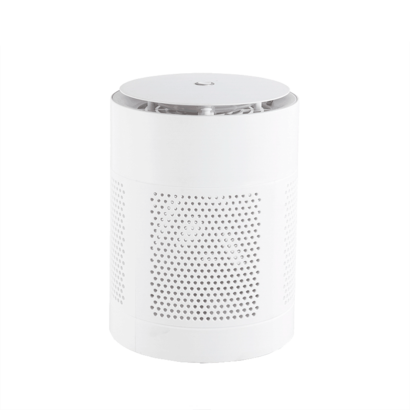
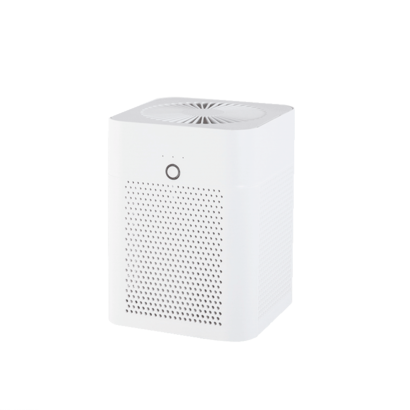
Mini and compact air purifiers operate on the same fundamental principles as full-size units — fan-driven airflow through a filter sequence — but their smaller dimensions mean every parameter is scaled down accordingly. Understanding these differences helps set realistic expectations for what a compact unit can achieve.
A mini air purifier has a smaller fan and smaller filter area, which directly limits its CADR. A compact unit might deliver a CADR of 30 to 80 CFM, compared to 150 to 400 CFM for a full-size room purifier. This makes mini units best suited for personal zones and small rooms of 10 to 25 square meters rather than large open-plan living spaces. When used appropriately — placed close to the user's breathing zone, such as on a bedside table or desk — a mini purifier can deliver highly effective personal air quality improvement within its effective range.
Smaller fans running at lower speeds generate less airflow turbulence and mechanical noise. Many mini air purifiers operate at under 30 dB on their lowest setting — quieter than a whispered conversation — making them particularly well suited for bedrooms and personal workspaces where noise is a primary consideration. This quiet operation is one of the most valued attributes of compact units for nighttime use.
Smaller filter surface areas reach saturation faster than large filter cartridges handling equivalent air volumes. In a polluted environment or with continuous operation, a mini purifier's HEPA and carbon filters may need replacement every 2 to 4 months rather than the 6 to 12 months typical of full-size unit filters. Regular filter checks are proportionally more important for compact units to maintain performance.
Mini air purifiers typically consume 5 to 25 watts of power — significantly less than full-size units — making them economical to run continuously. Their light weight and compact dimensions also make them portable between rooms or suitable for travel use in hotel rooms and temporary accommodations, extending their practical utility well beyond a single fixed location.
The health case for air purifiers is strongest for individuals with documented sensitivities to airborne allergens and irritants. By continuously reducing the concentration of triggers in the indoor environment, air purifiers can meaningfully lower the frequency and severity of symptoms — though they work best as part of a broader environmental management strategy rather than a standalone remedy.
Common allergens — pollen, dust mite allergen particles, pet dander, and mold spores — are all captured effectively by true HEPA filters. Studies have documented that HEPA air purifiers can reduce airborne cat allergen levels by more than 50% within one hour in a closed room, and sustained use produces cumulative reductions over days and weeks of continuous operation. For seasonal allergy sufferers, running a purifier in the bedroom throughout pollen season can significantly reduce overnight allergen exposure at the time the body most needs rest and recovery.
Asthma triggers span both particulate and gaseous categories — dust, smoke, chemical fumes, pet dander, and strong odors can all provoke airway inflammation and bronchoconstriction. A combination HEPA and activated carbon air purifier addresses both categories simultaneously, making it the most appropriate configuration for asthma management. Reducing the total burden of airborne triggers in the home environment can reduce reliance on reliever medication and improve overall respiratory comfort.
Humans spend approximately one-third of their lives sleeping, during which the respiratory system is continuously exposed to whatever is in bedroom air. For individuals with allergies or respiratory conditions, reducing airborne allergens and irritants in the sleeping environment through continuous overnight purifier operation is one of the highest-return applications of air purification technology, directly influencing sleep quality, morning symptoms, and overall daytime wellbeing.
Since cleaner air is invisible, many users are uncertain whether their purifier is functioning as it should. Several practical indicators confirm that the unit is operating effectively.

@2020. CIXI XIATIAN ELECTRICAL APPLIANCES CO.,LTD. All rights reserved. Wholesale High-End Electric Fans Manufacturers

 English
 한국어
한국어