

A handy fan is a compact, ultraportable personal cooling device designed to circulate air directly around the user wherever they go. Small enough to fit in a bag, pocket, or sit on a desk, a handy fan typically runs on rechargeable batteries or USB power, operates quietly across multiple speed settings, and provides immediate personal cooling relief without the bulk, noise, or fixed positioning of conventional electric fans. It is the go-to cooling solution for commuters, travelers, office workers, outdoor enthusiasts, and anyone who needs personal comfort in warm or poorly ventilated environments.
Content
A handy fan operates on the same basic principle as any electric fan — a motor drives rotating blades that move air, creating airflow that accelerates the evaporation of perspiration from the skin and produces a perceived cooling effect even without lowering the actual air temperature. What distinguishes a handy fan from a standard desk or floor fan is its miniaturized form factor and self-contained power supply.
Most handy fans use a brushless DC motor — a design that offers higher energy efficiency, quieter operation, and longer service life than older brushed motor designs. The motor drives fan blades engineered to maximize airflow per unit of electrical power, allowing a small device to generate a surprisingly effective airstream. Quality handy fans produce airflow speeds of 2 to 5 meters per second at the blade face — enough to provide noticeable cooling relief in still air conditions at distances of up to 30–50 cm from the device.
Because a handy fan moves air rather than cooling it, its effectiveness is greatest when used in combination with the skin's natural perspiration — the moving air accelerates moisture evaporation, which draws heat away from the body. This makes handy fans particularly effective in warm, humid outdoor conditions and in air-conditioned spaces where a subtle improvement in perceived temperature can make the difference between comfortable and uncomfortable.
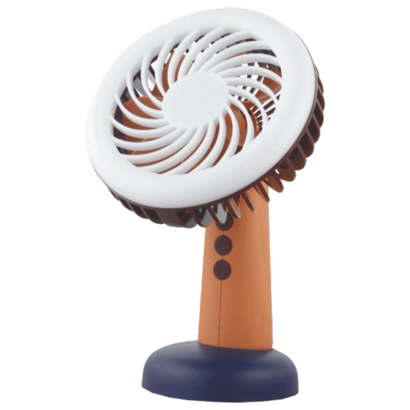
Not all handy fans are equal in performance or practicality. Several features distinguish genuinely useful portable fans from low-quality alternatives.
A quality handy fan offers at least two speed settings — typically a low setting for quiet, energy-efficient operation during mild heat and a high setting for maximum cooling when needed. More advanced models offer three or more speed levels, giving users precise control over airflow intensity and battery consumption. The ability to run at low speed is particularly valuable in office environments where noise and disruption to others must be minimized.
Battery life is a critical practical consideration for any portable fan. Most mid-range handy fans equipped with 2,000–4,000 mAh lithium batteries deliver between 3 and 8 hours of continuous operation on a full charge at low speed, and 1.5 to 4 hours at high speed. Premium models with larger battery capacities can exceed 10 hours of low-speed operation — sufficient for a full working day without needing to recharge. USB-C charging has become the standard for modern handy fans, enabling recharging from power banks, laptop ports, or standard USB chargers.
Operating noise is one of the most important differentiators between handy fan models. Quality handy fans produce between 25 and 45 decibels at typical operating distances — equivalent to a quiet library environment — making them suitable for use in offices, classrooms, libraries, and public transport without disturbing others. Poorly designed fans with cheap motors and unbalanced blades can produce 55 dB or more, limiting their practical usability in shared environments.
The defining advantage of a handy fan is its size and weight. Most handy fans weigh between 100 and 250 grams and measure 10–18 cm in their largest dimension — small enough to fit in a jacket pocket, handbag, or backpack side pocket without adding meaningful bulk. Many designs include a folding handle or integrated stand that allows the fan to be handheld or placed on a desk surface, giving users flexibility in how they deploy the device.
The handy fan category covers several distinct design formats, each optimized for slightly different use cases and carrying preferences.
| Type | Design | Best Use Case | Key Advantage |
|---|---|---|---|
| Handheld fan | Compact with grip handle | Outdoor events, commuting, travel | Directed airflow; simple one-hand use |
| Mini desk / table fan | Small base with tilt adjustment | Office, study, bedside table | Hands-free operation; stable placement |
| Clip-on fan | Integrated clamp for attachment | Strollers, tents, bed frames, desks | Versatile mounting; frees up surface space |
| Neck / wearable fan | U-shaped; rests on shoulders | Outdoor activities, shopping, festivals | Completely hands-free; continuous cooling |
| Folding / pocket fan | Foldable blades, ultra-compact | Everyday carry, minimal bag space | Smallest footprint; pocket-sized storage |
The versatility of the handy fan is one of its greatest strengths. Unlike fixed fans or air conditioning, it goes wherever the user goes — making it useful across a wide range of everyday situations.
While both device types serve the same fundamental purpose, the differences between a handy fan and a conventional desk or tower fan are significant in practical terms — each suits different user needs and environments.
With a wide range of models available at different price points, a few key specifications help identify a handy fan that will genuinely perform well in daily use.

@2020. CIXI XIATIAN ELECTRICAL APPLIANCES CO.,LTD. All rights reserved. Wholesale High-End Electric Fans Manufacturers

 English
 한국어
한국어