

The core difference is straightforward: a floor fan is a lightweight, portable appliance built for personal or room-level comfort, while an industrial electric fan is a heavy-duty, high-performance machine engineered to move large volumes of air across warehouses, factories, and commercial spaces. If you need to cool a bedroom or office, a floor fan does the job. If you need to ventilate a 20,000 sq ft manufacturing floor or maintain safe temperatures in a food processing plant, an industrial electric fan is the only practical solution.
Understanding the full picture — motor type, airflow capacity, blade design, durability, and safety features — helps you make the right purchasing or specification decision. Below, we break down every major dimension so you can confidently distinguish between these two very different categories of air-moving equipment.
Content
Airflow is measured in cubic feet per minute (CFM), and the gap between floor fans and industrial electric fans is enormous.
| Fan Type | Typical CFM Range | Effective Coverage Area | Typical Blade Diameter |
|---|---|---|---|
| Floor Fan (residential) | 500 – 2,500 CFM | Up to ~400 sq ft | 12" – 20" |
| Industrial Electric Fan | 5,000 – 50,000+ CFM | 5,000 – 30,000+ sq ft | 24" – 72"+ |
A standard 20-inch floor fan might push around 2,000 CFM — enough to cool a single room. An industrial electric fan with a 24-inch or larger blade can deliver 10,000 CFM or more, making it capable of cooling entire production lines, loading docks, or open-bay warehouses in one continuous air sweep.
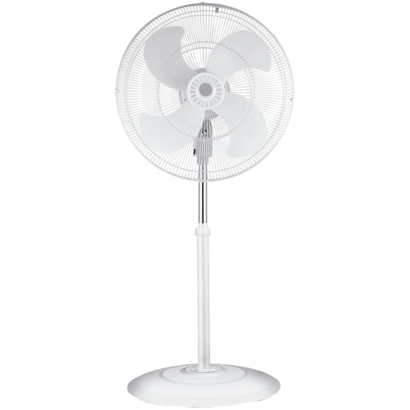
The motor is where industrial electric fans truly separate themselves from consumer floor fans. Most residential floor fans use an AC induction motor rated between 30 and 100 watts, designed for intermittent or moderate daily use. These motors are inexpensive, lightweight, and adequate for home environments where the fan might run 8–12 hours a day.
Industrial electric fans are built around permanent-magnet motors or high-efficiency AC motors rated from 1/4 HP to over 2 HP (roughly 186W to 1,500W+). A permanent-magnet motor provides several key advantages in demanding environments:
In contrast, running a typical floor fan motor continuously at maximum speed in a hot warehouse environment can cause overheating and premature failure within weeks or months.
Floor fans are primarily made from lightweight ABS plastic and thin stamped steel. They are not intended to withstand impacts, dust accumulation, moisture exposure, or the physical demands of an industrial setting. Most residential floor fans carry a warranty of 1–2 years and are built to a price point.
Industrial electric fans are engineered for punishment. Key construction features include:
Many industrial fans are also designed with IP-rated enclosures (e.g., IP44 or IP55), meaning they are protected against solid particles and water splashes — critical in food and beverage processing environments where regular washdowns are required.
Safety is a major differentiator. A floor fan typically features a simple wire or plastic guard that meets minimum residential safety standards. It is not designed to withstand being kicked, bumped by a forklift, or knocked over repeatedly.
Industrial electric fans incorporate safety features that align with OSHA and industry workplace standards:
Floor fans are designed primarily for easy portability. They typically weigh between 5 and 15 lbs and can be moved from room to room by a single person without tools or effort. The trade-off is that they have limited mounting versatility — they sit on the floor or a table.
Industrial electric fans offer far more deployment flexibility to suit large, complex workspaces:
The extended mounting bar found on many industrial fan models also serves a practical purpose: it allows workers to angle the fan's output precisely toward work zones, equipment that generates heat, or areas where heat stratification is a problem.
Most floor fans offer 3-speed settings controlled by a simple dial or push-button. Some premium models add remote controls or oscillation, but the control range remains narrow and the speeds are fixed at low, medium, and high.
Industrial electric fans go further. Many feature adjustable torque systems that allow operators to fine-tune the rotational speed of the fan to precisely match the cooling or ventilation demand of the space. This is particularly valuable in environments where:
Some industrial fan models also support integration with building management systems (BMS) or thermostatic controllers, enabling automated speed adjustment based on real-time temperature readings.
The stakes of choosing the wrong fan in an industrial setting go beyond comfort. Research consistently links elevated workplace temperatures to reduced productivity and increased safety risk. According to occupational health studies, worker productivity can decline by up to 2% for every degree Celsius above 25°C (77°F) in physically demanding jobs. In a warehouse operating at 38°C (100°F), that represents a potential 26% productivity loss compared to a properly cooled environment.
Beyond productivity, heat stress is a genuine safety hazard. OSHA estimates that thousands of workers suffer heat-related illnesses annually, including heat exhaustion and life-threatening heat stroke. Industrial electric fans play a direct role in mitigating this risk by keeping workers cool, motivated, and refreshed throughout long shifts — something a residential floor fan, with its limited airflow range, simply cannot achieve in a large open space.
Floor fans are engineered with noise reduction in mind. A quality residential floor fan typically operates between 40 and 55 dB — comparable to a quiet conversation — making it suitable for sleeping or working in silence.
Industrial electric fans are louder by design, commonly producing 65 to 85 dB at full speed. In industrial environments, this is generally acceptable given the ambient noise levels already present from machinery and equipment. However, it means industrial fans are entirely unsuitable for office environments, schools, or healthcare settings where noise would be disruptive. For personnel working near industrial fans for extended periods, hearing protection may be recommended depending on the overall workplace noise level.
| Feature | Floor Fan | Industrial Electric Fan |
|---|---|---|
| Primary Use | Home / small office | Warehouse / factory / construction |
| Airflow (CFM) | 500 – 2,500 | 5,000 – 50,000+ |
| Motor Type | AC induction (30–100W) | Permanent-magnet / high-efficiency AC (up to 1,500W+) |
| Duty Cycle | Intermittent / residential | 24/7 continuous |
| Construction | Plastic / light steel | Heavy-gauge steel, enclosed ball bearings |
| Noise Level | 40 – 55 dB | 65 – 85 dB |
| Safety Features | Basic plastic/wire guard | High-visibility guard, thermal overload, IP-rated options |
| Speed Control | 3-speed dial/button | Adjustable torque / BMS integration |
| Expected Lifespan | 2 – 5 years | 7 – 20+ years |
Choosing between a floor fan and an industrial electric fan comes down to three practical questions:
If you are outfitting a home, apartment, or small retail space, a well-made floor fan is a perfectly rational, cost-effective choice. If you are responsible for the comfort, safety, and productivity of workers in any industrial, construction, or large commercial environment, an industrial electric fan is not an upgrade — it is the minimum appropriate solution.


@2020. CIXI XIATIAN ELECTRICAL APPLIANCES CO.,LTD. All rights reserved. Wholesale High-End Electric Fans Manufacturers

 English
 한국어
한국어