

The core difference is this: an industrial electric fan is engineered to move large volumes of air continuously, reliably, and safely in demanding commercial or industrial environments, while a standard electric fan is designed for occasional personal comfort use in homes and offices. Industrial fans are built from heavier materials, use more powerful motors, operate for extended duty cycles, and are constructed to withstand heat, dust, moisture, vibration, and harsh conditions that would quickly damage a consumer-grade fan. A standard desk or tower fan might move 200–400 cubic feet per minute (CFM) of air; an industrial floor fan can move 3,000–10,000 CFM or more — enough to ventilate an entire warehouse bay.
Both are electric fans in the basic sense — a motor spins blades to move air — but the engineering specifications, materials, safety standards, airflow capacity, and intended use cases are in entirely different categories. Choosing the wrong type for your application leads either to wasted money (using an industrial fan in a bedroom) or to safety risks and ineffective ventilation (using a household fan in a warehouse or factory floor).
Content
Before diving into the details, the following table summarizes the most important differences between industrial electric fans and standard household electric fans across all major performance and design dimensions:
| Parameter | Industrial Electric Fan | Standard Electric Fan |
|---|---|---|
| Airflow Capacity (CFM) | 3,000–20,000+ CFM | 150–500 CFM |
| Motor Type | Permanent magnet or induction motor; continuous duty | Small AC or DC motor; intermittent duty |
| Motor Power | 0.25 HP – 10+ HP (186W – 7,500W+) | 15W – 75W |
| Blade Diameter | 12 inches – 72 inches (30–183 cm) | 6 – 18 inches (15–46 cm) |
| Build Materials | Steel, cast iron, heavy-duty aluminum alloy | Lightweight plastic, thin ABS |
| Duty Cycle | Continuous (24/7 rated) | Intermittent (hours per day) |
| Noise Level | 65–90 dB (high airflow priority) | 30–55 dB (quiet comfort priority) |
| Safety Features | Metal guard, enclosed bearings, thermal overload protection, high-vis markings | Plastic safety cage, tip-over switch |
| Typical Price Range | $80 – $2,000+ | $15 – $150 |
| Service Life | 10–20+ years with maintenance | 2–7 years typical |
| Typical Environment | Warehouses, factories, construction sites, food processing | Homes, offices, small retail spaces |
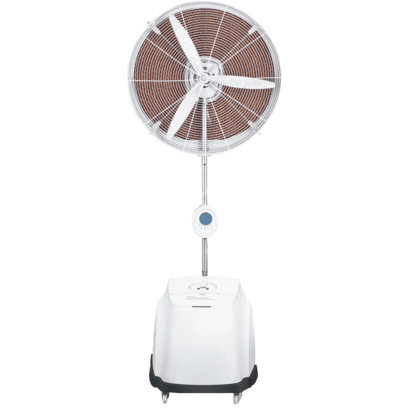
The motor is the heart of any electric fan, and the gap between industrial and consumer-grade motors is substantial. Understanding the motor difference explains almost every other performance distinction between the two fan categories.
Industrial electric fans typically use one of two motor types: permanent magnet motors or induction (TEFC — Totally Enclosed Fan-Cooled) motors. Permanent magnet motors provide consistent torque across the full speed range and are highly efficient, while TEFC induction motors are the workhorse of heavy industrial applications due to their sealed construction that prevents dust, moisture, and contaminants from entering the motor windings.
Industrial fan motors are rated for continuous duty operation — meaning they are designed and thermally rated to run at full load indefinitely without rest periods. Motor power ranges from 0.25 HP (186W) for compact industrial fans to 10 HP (7,460W) or more for large axial fans in major industrial installations. The windings use heavier gauge wire with higher temperature insulation ratings (typically Class F or Class H insulation, rated to 155°C and 180°C respectively), and the bearings are sealed, lubricated precision ball bearings engineered for long service intervals.
Consumer electric fans use small shaded-pole AC motors or brushless DC motors drawing 15–75 watts of power. These motors are designed for intermittent operation — a few hours per day — and are not thermally rated for continuous extended use. Running a standard household fan continuously for 24 hours a day in a hot environment can lead to motor overheating, insulation breakdown, and fire risk — a scenario that an industrial motor handles without issue.
The bearings in consumer fans are often sleeve bearings (oil-impregnated sintered bronze) rather than ball bearings. Sleeve bearings are quieter and cheaper but wear faster under continuous load, leading to motor wobble, vibration, and eventual failure after a few thousand hours of operation. Industrial enclosed ball bearings, by contrast, are rated for 50,000–100,000+ hours of operation, which at 24/7 operation represents 5–11 years of continuous running.
Airflow capacity — measured in cubic feet per minute (CFM) or cubic meters per hour (m³/h) — is the most practically important performance specification for any fan, because it determines whether the fan can actually ventilate or cool the space it is installed in.
The volume of air a fan can move is determined by three factors: blade diameter, blade pitch angle, and rotational speed (RPM). Industrial fans achieve dramatically higher CFM than consumer fans by using significantly larger blades — typically 18 inches to 72 inches (45 cm to 183 cm) in diameter — combined with steep blade pitch angles and motors powerful enough to spin large-diameter blade assemblies effectively.
To put this in practical terms: a standard 18-inch desk or pedestal fan might move 300–500 CFM of air, which is sufficient to create a cooling breeze for one or two people within about 3 meters. A 24-inch industrial floor fan moves approximately 5,000–7,000 CFM, enough to create meaningful air movement across a space of 500–800 square feet. A large 72-inch industrial HVLS (High Volume, Low Speed) ceiling fan can move 100,000+ CFM, covering an entire warehouse floor.
This difference is not just about comfort — it has direct implications for heat stress management in workplaces, fume and dust dilution, evaporative cooling efficiency, and compliance with occupational health ventilation requirements that no consumer fan could meet.
The physical construction of industrial and consumer fans reflects completely different operating environments and durability requirements.
Industrial fans are built from heavy-gauge steel, cast aluminum alloy, or stainless steel depending on the application. The structural frame and blade guard are designed to withstand physical impacts — from forklifts, falling objects, and rough handling on construction sites — without fracturing or compromising the blade protection. Guards are typically made from welded steel wire or stamped steel mesh, engineered to contain a blade fragment in the unlikely event of blade failure. High-visibility colors (industrial yellow, orange, or safety green) are used on blade guards to ensure the fan's operating state is immediately obvious in busy workplaces.
Blades on industrial fans are commonly made from reinforced polypropylene, glass-fiber-reinforced nylon, or aluminum alloy. These materials maintain structural integrity under the significant centrifugal forces generated by large-diameter blades spinning at operating speeds, and resist the fatigue cracking that can occur with prolonged vibration. Industrial fan housings and motor enclosures are rated to IP (Ingress Protection) standards — commonly IP54 or IP55, indicating protection against dust ingress and water splash from any direction — enabling safe operation in wet production environments, outdoor construction sites, and humid warehouses.
Standard household fans are constructed primarily from injection-molded ABS plastic for the housing, base, and blade guard. Plastic construction keeps weight and manufacturing cost low, which is appropriate for a product designed to be moved between rooms in a home. However, plastic becomes brittle with UV exposure and prolonged heat, cracks on impact, and degrades faster in dusty, chemically active, or high-temperature environments. Consumer fan blade guards are designed to prevent accidental finger contact rather than to contain failed blade fragments, and their structural integrity under industrial impact loads is minimal.
Consumer fans are not rated to any IP standard and are explicitly not designed for wet or dusty environments. Operating a standard household fan in a dusty workshop or near water will lead to dust accumulation on motor windings (increasing fire risk), moisture ingress through ventilation slots, and accelerated bearing wear.
Safety requirements diverge significantly between industrial and consumer fans, reflecting the very different risk profiles of their operating environments.
Standard household fans include safety features appropriate for domestic use: plastic safety cages with blade gap sizes small enough to prevent most finger injuries, tip-over automatic shut-off switches (required for free-standing pedestal and tower fans in many markets), and basic thermal fuses that permanently cut power if a motor severely overheats. These features address the risk profile of a domestic environment — accidental contact by children, unstable placement on uneven surfaces — but do not meet the more demanding requirements of industrial settings where continuous operation, physical abuse, and electrical load cycling are the norm.
"Industrial electric fan" covers a broad family of products, each designed for specific industrial airflow requirements. Understanding the main types clarifies the full scope of what industrial fans do:
| Fan Type | Typical Airflow | Typical Power | Primary Application |
|---|---|---|---|
| Industrial Floor Fan (Drum / Barrel Fan) | 3,000–8,000 CFM | 0.25–1 HP | Warehouses, construction sites, drying areas, worker cooling |
| Industrial Pedestal / Column Fan | 2,000–5,000 CFM | 0.1–0.5 HP | Workshop floors, production lines, loading docks |
| Wall-Mounted Industrial Fan | 3,000–12,000 CFM | 0.25–2 HP | Manufacturing facilities, gymnasiums, large retail spaces |
| Blower Fan (Centrifugal) | 500–5,000 CFM | 0.1–5 HP | Duct systems, drying ovens, confined space ventilation, HVAC |
| HVLS Ceiling Fan (High Volume Low Speed) | 50,000–200,000+ CFM | 1–3 HP | Large warehouses, distribution centers, aircraft hangars |
| Explosion-Proof Fan | 1,000–15,000 CFM | 0.5–5 HP | Chemical plants, paint booths, fuel storage, mining |
| Portable Ventilation / Blower Fan | 1,000–4,000 CFM | 0.25–1 HP | Construction sites, confined space entry, tunnel work |
This range of industrial fan types illustrates that "industrial electric fan" is not a single product but a family of engineered airflow solutions, each optimized for a specific application scale and environment. The smallest compact industrial fan (a 12-inch drum fan) still outperforms the most powerful consumer tower fan in raw airflow output.
Standard electric fans also come in multiple configurations, optimized for personal comfort in domestic and light commercial environments:
The noise output of industrial fans is significantly higher than consumer fans — a direct consequence of larger blade diameters, higher airflow volumes, and more powerful motors. This is not a design flaw but a deliberate engineering trade-off: in industrial environments, high airflow output takes priority over quiet operation.
Typical noise levels at 1 meter:
This noise difference makes standard electric fans entirely unsuitable for most industrial ventilation tasks (too quiet = too weak) and makes most industrial fans unsuitable for homes and offices (too loud for comfortable habitation). The HVLS ceiling fan is an important exception — it is an industrial-capacity fan (massive airflow) with consumer-level noise, achieved through the physics of very large, slow-turning blades. This is why HVLS fans are increasingly used in large retail spaces and sports arenas where both high airflow and acceptable noise levels are required.
Both industrial and consumer fans have evolved significantly in energy efficiency, but the comparison must be made on an airflow-per-watt basis rather than absolute power consumption, since the two categories move vastly different volumes of air.
A useful metric is CFM per watt — how much air the fan moves per unit of electrical energy consumed:
This analysis shows that industrial fans — particularly HVLS designs — are significantly more energy-efficient at moving air per watt than consumer fans. When industrial fans use modern permanent magnet motors or EC (electronically commutated) motor technology, efficiency improves further. Variable speed drives (VSDs) on industrial fans allow speed to be matched to actual airflow demand, reducing energy consumption by up to 50% compared to fixed-speed operation when full airflow is not required.
In absolute terms, running an industrial fan continuously costs more per day than running a consumer fan — simply because the industrial unit moves 10–50× more air and uses proportionally more power. But on a cost-per-CFM-of-airflow basis, industrial fans deliver better value per unit of ventilation achieved.
Understanding the specific environments where industrial fans are required — and why standard fans fail in those environments — makes the category distinction concrete and practical:
A typical distribution warehouse of 50,000 square feet with a 30-foot ceiling height contains 1.5 million cubic feet of air. Moving this air volume effectively requires fans capable of generating thousands of CFM of directed airflow to break up heat stratification (where hot air accumulates near the ceiling, leaving the working zone insufferably hot) and create cooling air movement at floor level where workers operate. Consumer fans placed on warehouse floors create a small zone of air movement that dissipates within a few meters. Industrial floor fans, wall-mount fans, and HVLS ceiling fans create air movement patterns that span the entire building.
Food processing environments present specific challenges: high humidity from steam and washing operations, temperature extremes from cooking and refrigeration zones, strict hygiene requirements, and chemical exposure from cleaning agents. Industrial fans for food processing must be constructed from stainless steel or food-grade sealed materials, rated to high IP protection levels (IP65–IP67 for washdown applications), and free from surfaces where bacteria can accumulate. Standard consumer fans are entirely unsuitable for food processing environments from both hygiene and durability perspectives.
Active construction sites require fans for concrete drying acceleration, paint and adhesive fume ventilation in enclosed spaces, worker cooling during summer operations, and temporary space heating (when used with heating elements). Construction environments expose fans to concrete dust, drywall dust, paint spray, solvent vapors, and physical impacts from tools and materials. A consumer fan placed on a construction site would be damaged by dust within days, present fire risk from combustible dust accumulation on motor windings, and lack the airflow capacity to meaningfully ventilate even a single floor of a building under construction.
Manufacturing facilities generate heat from machinery, welding operations, and chemical processes, creating thermal environments that impair worker performance and safety. Research on industrial heat stress consistently shows that worker productivity declines by up to 2% per degree Celsius above 25°C in physically demanding tasks. Effective industrial ventilation that maintains working zone temperatures at acceptable levels directly protects worker health under occupational health regulations and maintains the productivity that justifies the capital investment in the fans themselves.
Poultry houses, pig barns, and dairy facilities require continuous ventilation to control temperature, humidity, ammonia concentration, and airborne pathogen levels for both animal welfare and production performance. Agricultural ventilation fans must operate continuously for months, withstand high ammonia and moisture concentrations, and move sufficient air volume to exchange the air in a large building 20–40 times per hour in summer conditions. Consumer fans cannot provide this ventilation rate or survive the corrosive agricultural atmosphere.
Both industrial and consumer fans address the need for positioning flexibility, but in different ways suited to their respective environments.
Many portable industrial fans — particularly the drum fan format used on construction sites — are designed with carry handles, fold-flat designs, and collapsible mounting bars that allow easy repositioning between work areas. Some designs include a mounting bar up to 4 feet (120 cm) long with the fan head attached at one end, allowing the fan to be positioned at height, aimed horizontally across a work area, or directed upward for ceiling bounce airflow without requiring a separate stand. The fan head may fold flat against the bar for transport and storage, making the unit compact when not in use despite its industrial-scale airflow capacity.
Adjustable torque systems or variable speed controls — either mechanical (in simpler designs) or electronic (in premium designs) — allow industrial fan operators to match airflow output to current requirements, reducing noise and energy use when full airflow is not needed while providing maximum output during peak heat conditions or active ventilation operations.
Standard electric fans typically offer 2–4 speed settings via mechanical or electronic switches, oscillation (left-right sweeping) for wider air distribution, and height adjustment on pedestal models. Premium consumer fans include sleep timers, remote controls, programmable schedules, smart home connectivity (Wi-Fi/app control), and noise-optimized "sleep modes" that run at minimum speed and noise for nighttime use. These comfort-oriented features are entirely absent from industrial designs, reflecting the different priorities of home comfort versus industrial ventilation.
The higher upfront cost of industrial fans is frequently offset by their longer service life, lower per-hour operating cost when amortized over years of continuous use, and the significant productivity and safety value they deliver in appropriate applications.
| Cost Factor | Industrial Fan (24-inch floor fan) | Consumer Fan (18-inch pedestal) |
|---|---|---|
| Initial purchase cost | $200–$400 | $40–$80 |
| Expected service life | 10–20 years | 3–5 years |
| Units needed over 10 years | 1 | 2–3 |
| Total purchase cost (10 years) | $200–$400 | $80–$240 |
| Daily power cost (8 hr/day at $0.15/kWh) | $0.30 (250W motor) | $0.06 (50W motor) |
| Maintenance requirements | Bearing lubrication, blade inspection | Minimal (typically replace unit) |
| Airflow delivered | 5,000+ CFM | 300–500 CFM |
The analysis shows that for industrial applications requiring serious airflow, the industrial fan is not just the right tool — it is often the more economical long-term choice when total cost of ownership is calculated. For home use, the consumer fan's lower purchase price, lower running cost, and adequate performance for personal comfort make it the obviously correct choice. Matching the fan to the application is the key to optimizing both cost and performance.
Use the following decision criteria to determine which type of fan is appropriate for your situation:


@2020. CIXI XIATIAN ELECTRICAL APPLIANCES CO.,LTD. All rights reserved. Wholesale High-End Electric Fans Manufacturers

 English
 한국어
한국어